Stay lock fence
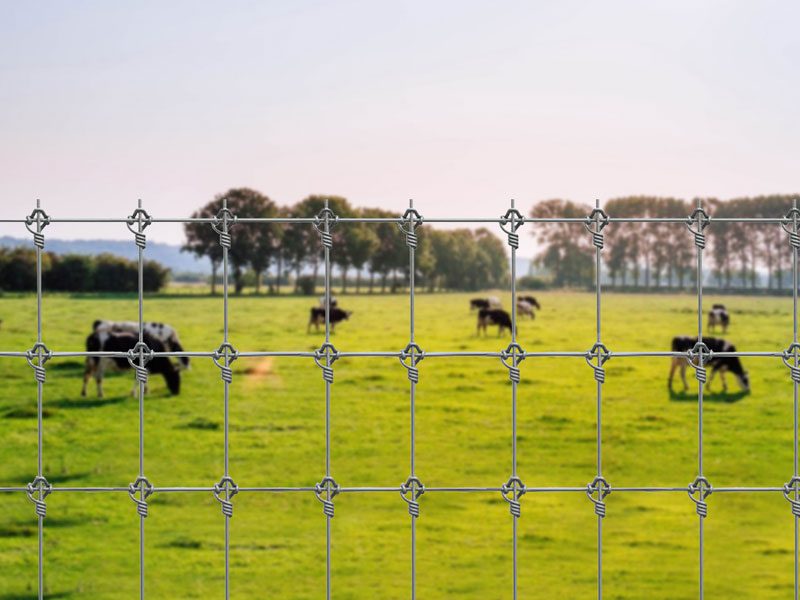
Fixed-knot farm fence with solid vertical stays and tighter mesh near the ground.
Updated 16 October 2026 · Made by Nitin Wire Group, Chennai · +91 91591 43131
Stay Lock Fence specifications
| Roll sizes | 4 ft × 66 ft, 5 ft × 66 ft |
|---|---|
| Wire | High-tensile, heavy-duty galvanised |
| Knot | Stay-lock knot |
| Vertical wires | Solid stay wires |
| Line wire spacing | Graduated, narrower towards the ground |
| Line wires | Tension curve |
What makes it work
- Locking knot
The stay-lock knot holds every joint so wires will not slip vertically or horizontally.
- Solid vertical stays
Stays resist bending and folding, absorb animal impacts and tolerate wider post spacing.
- Graduated spacing
Smaller openings near the ground keep small animals from getting in or out.
- Built for rough ground
Rigid mesh and tension curves suit long runs over varied or difficult terrain.
- Uniform zinc coating
Extra, evenly applied galvanising for weather resistance and long life.
Stay Lock Fence applications

Agriculture & Farming
Keep cattle, goats and wild boar out of crops, and livestock in.

Construction & Real Estate
Site boundaries, plot fencing and safety netting, supplied in bulk.

Manufacturing Unit
Perimeter, compound wall and machine-area security for industrial sites.

Warehouse
Perimeter security, internal partitions and secure storage areas.
Stay Lock Fence: questions buyers ask
What is stay lock fence used for?
Stay lock fence is used mainly for livestock and farm boundaries: cattle, goat, deer, horse and dog fencing. Its locked knots and solid vertical stays keep the mesh rigid over long distances and uneven ground, and its narrower bottom openings stop small animals slipping through.
Stay lock fence or chain link: which is better for a farm?
For large farms and livestock, stay lock fence is usually the better fit: high-tensile wire and solid stays tolerate wider post spacing, so fewer posts are needed, and the mesh copes with uneven ground. Chain link has smaller openings and suits small plots, poultry or boundaries that need a tighter mesh.
How far apart should posts be for a stay lock fence?
Because solid stays keep the mesh rigid, stay lock fence tolerates wider post spacing than ordinary woven farm fence. As general practice, line posts are often set around 4 to 6 metres apart on level ground and closer on slopes or curves, with strong braced posts at ends and corners.
How many rolls of stay lock fence do I need?
Each Nitin roll is 66 ft long, about 20 metres. Divide your boundary length in metres by 20 and round up: a 400 m perimeter needs 20 rolls. Choose the 4 ft or 5 ft height depending on the animals you need to hold or keep out.
Does stay lock fence stop small animals?
Stay lock fence uses graduated wire spacing, with the horizontal wires closer together near the ground. This narrower bottom mesh deters smaller animals from crossing into or out of the field while keeping larger openings higher up where they are not needed.